RESEARCH
Applied research for decisions that have consequences.
Research at LSG Labs starts with a real operational uncertainty, then tests whether a technical approach improves the decision without removing human responsibility.

01 — QUESTION
Define the operational uncertainty first.
The useful question is not whether a model can produce an answer. It is whether a team can make a better, safer or faster decision with the evidence available.
Applied research starts with an uncertainty that affects real work: a decision that cannot be made consistently, a source that cannot be trusted in isolation or a hand-off that repeatedly loses context.
Framing that uncertainty precisely keeps the work useful. It establishes what would count as a better outcome and prevents a technology choice from becoming the question before the operational need is understood.

02 — EVIDENCE
Combine sources with different strengths.
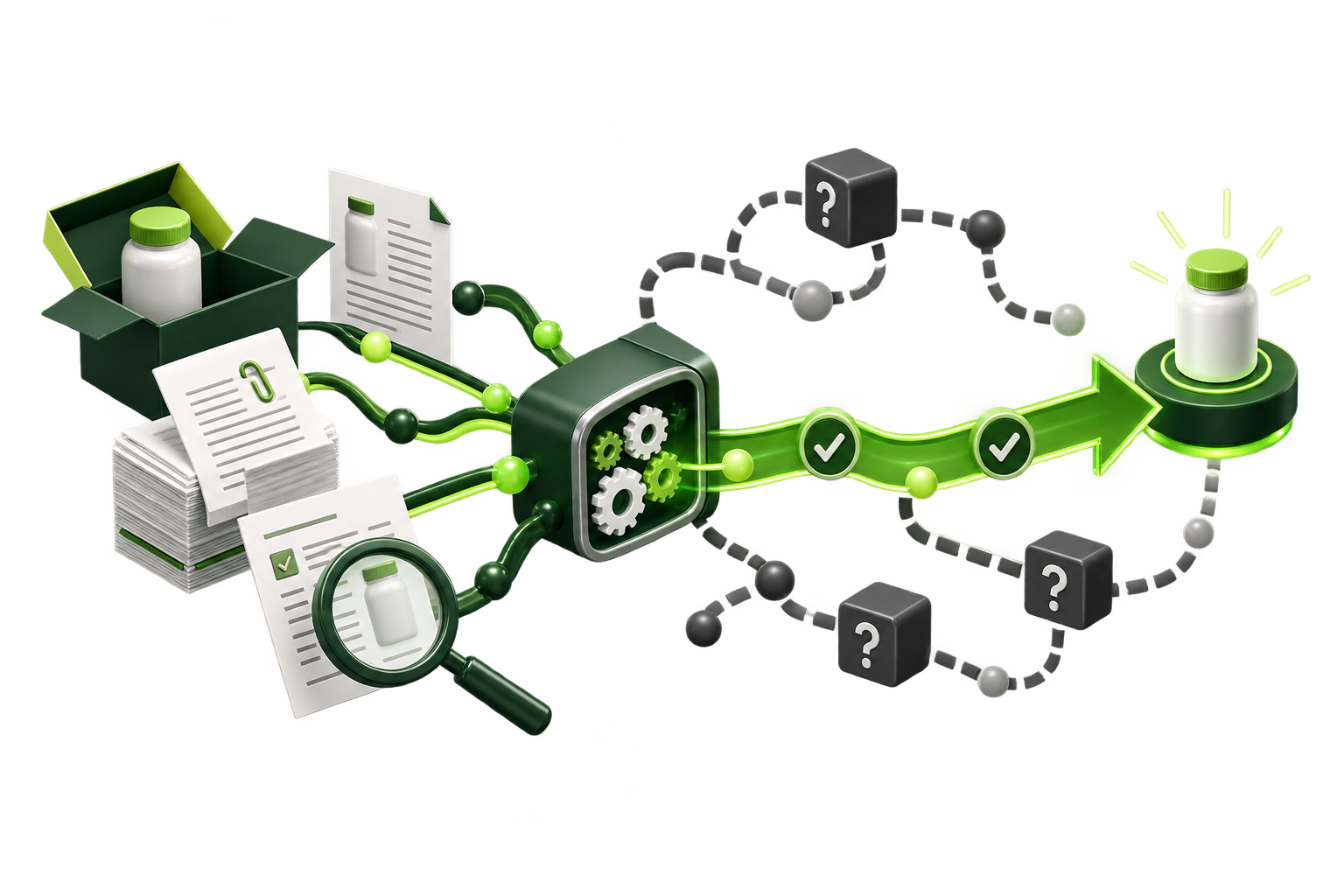
OCR, structured identifiers and visual retrieval have different failure modes. Applied research examines how they can be combined and where they disagree.
Operational evidence rarely arrives in one complete form. Documents, records, images and operator knowledge have different strengths and limitations; bringing them together makes those differences visible instead of forcing them into a false uniformity.
The result is a more grounded basis for design and engineering decisions. Sources can be compared, gaps can be identified and the next validation step can be chosen deliberately.

03 — VALIDATION
Test the review path, not only the output.
A proposed result is only useful if a reviewer can understand the source, inspect uncertainty and correct it efficiently.
A promising output is not enough if the way it is reviewed cannot work in day-to-day operations. Validation therefore examines the route from input to decision: what evidence is available, who needs to interpret it and what happens when the result is uncertain.
Testing this path early helps distinguish a technically interesting idea from a capability that a team can actually adopt and improve over time.
04 — BOUNDARY
State what has not been proven.
We do not present an exploratory capability as a finished product, or a prototype as a deployed system.
Research is more credible when its boundaries are explicit. A result may be useful in one context, with one set of sources or under one review process without being ready to generalise beyond those conditions.
Stating those limits protects the quality of the next decision. It creates a clearer hand-off from exploration to product work and avoids presenting unvalidated assumptions as settled fact.

WORK WITH LSG LABS